Tag Archive for: osteotomy

Management of Deformities Around the Knee in Skeletal Dysplasia and a Review of Current Literature on Guided Growth in Skeletal Dysplasia

Volume 11 | Issue 1 | Januar-April 2025 | Page: 25-33 | Akash Kumar Ghosh, Puneeth K Pai, Vikas Ellur

DOI- https://doi.org/10.13107/ijpo.2025.v11.i01.218

Open Access License: CC BY-NC 4.0

Copyright Statement: Copyright © 2024; The Author(s).

Submitted: 14/02/2025; Reviewed: 26/02/2025; Accepted: 02/04/2025; Published: 10/04/2025


Authors: Akash Kumar Ghosh M.Ch (Paed. Ortho.) [1], Puneeth K Pai MS Ortho [1], Vikas Ellur MS Ortho [1]

[1] Department of Orthopaedics, Paediatric Orthopaedics Unit, Narayana Healthcity, Bengaluru, Karnataka, India.

Address of Correspondence

Dr. Akash Kumar Ghosh,
Department of Orthopaedics, Paediatric Orthopaedics Unit, Narayana Healthcity, Bengaluru, Karnataka, India.
E-mail: akashgh994@gmail.com


Abstract

Skeletal dysplasias are a heterogeneous group of disorders characterized by abnormal bone and cartilage formation, often presenting with complex lower limb deformities, particularly around the knee. This review provides a comprehensive overview of the current evidence regarding the management of knee deformities in skeletal dysplasias.
Deformities may arise due to asymmetric physeal. involvement, unequal growth of paired bones, or soft tissue contractures. A thorough history, comprehensive examination, and appropriate imaging are, essential for accurate assessment. Instrumented gait analysis provides valuable insights into the dynamic impact of deformities.
Treatment planning should consider the multifocal and multiplanar nature of deformities, unpredictable growth patterns, bone quality, and anesthetic risks. Guided growth is a safe and effective option for correcting coronal and sagittal plane deformities in children with at least two years of growth remaining. Acute correction using osteotomies and internal fixation is preferred when the center of rotation of angulation (CORA) is further from the physis. Gradual correction using external fixators is useful for multiplanar and multifocal deformities with limb length discrepancy. A multidisciplinary collaboration and astute planning are important for ensuring optimal outcomes in the management of knee deformities in skeletal dysplasias.
Keywords: Bone disease, Developmental, Osteotomy, Growth plate, Epiphysis, Guided growth 


References

1. Brown RR, Monsell F. Understanding the skeletal dysplasias. Current Orthopaedics. 2003;17:44–55.
2. Thacker MM, Ditro C, Mackenzie WGS, Mackenzie WG. Limb Lengthening and Deformity Correction in Patients with Skeletal Dysplasias. In: Sabharwal S, Iobst CA, editors. Pediatric Lower Limb Deformities: Principles and Techniques of Management [Internet]. Cham: Springer International Publishing; 2024 [cited 2025 Apr 6]. p. 537–59. Available from: https://doi.org/10.1007/978-3-031-55767-5_26
3. Borgo A, Cossio A, Gallone D, Vittoria F, Carbone M. Orthopaedic challenges for mucopolysaccharidoses. Ital J Pediatr. 2018;44:123.
4. Weiner DS, Tank JC, Jonah D, Morscher MA, Krahe A, Kopits S, et al. An operative approach to address severe genu valgum deformity in the Ellis-van Creveld syndrome. Journal of Children’s Orthopaedics. 2014;8:61–9.
5. Lee ST, Song HR, Mahajan R, Makwana V, Suh SW, Lee SH. Development of genu varum in achondroplasia: RELATION TO FIBULAR OVERGROWTH. The Journal of Bone & Joint Surgery British Volume. 2007;89-B:57–61.
6. Al Kaissi A, Kenis V, Melchenko E, Chehida FB, Ganger R, Klaushofer K, et al. Corrections of Lower Limb Deformities in Patients with Diastrophic Dysplasia. Orthopaedic Surgery. 2014;6:274–9.
7. Cho T-J, Choi IH, Chung CY, Yoo WJ, Park MS, Lee DY. Hemiepiphyseal Stapling for Angular Deformity Correction Around the Knee Joint in Children With Multiple Epiphyseal Dysplasia. Journal of Pediatric Orthopaedics. 2009;29:52.
8. Lachman RS. Neurologic abnormalities in the skeletal dysplasias: A clinical and radiological perspective. American Journal of Medical Genetics. 1997;69:33–43.
9. Horn J, Leardini A, Benedetti MG, Hestnes TM, Mindler G, Wekre LL, et al. Fully instrumented gait analysis in rare bone diseases – A scoping review of the literature. Gait & Posture. 2025;118:168–77.
10. Rego FRQ, Oliveira HFV de, Rolim Filho EL. Three-dimensional Evaluation of Gait: Kinetics, Kinematics, and Electromyographic in Patients with Mucopolysacharidosis Types IV and VI. Rev bras ortop. 2025;59:737–44.
11. Bayhan IA, Er MS, Nishnianidze T, Ditro C, Rogers KJ, Miller F, et al. Gait Pattern and Lower Extremity Alignment in Children With Diastrophic Dysplasia. Journal of Pediatric Orthopaedics. 2016;36:709.
12. Garman CR, Graf A, Krzak J, Caudill A, Smith P, Harris G. Gait Deviations in Children With Osteogenesis Imperfecta Type I. Journal of Pediatric Orthopaedics. 2019;39:e641.
13. Silva MS, Fernandes ARC, Cardoso FN, Longo CH, Aihara AY. Radiography, CT, and MRI of Hip and Lower Limb Disorders in Children and Adolescents. RadioGraphics. 2019;39:779–94.
14. Kraus M, Pertman L, Eshed I. What’s new in pediatric musculoskeletal imaging. Journal of Children’s Orthopaedics. 2025;19:109–18.
15. Meyrignac O, Moreno R, Baunin C, Vial J, Accadbled F, Sommet A, et al. Low-dose biplanar radiography can be used in children and adolescents to accurately assess femoral and tibial torsion and greatly reduce irradiation. Eur Radiol. 2015;25:1752–60.
16. Silva FD, Chemin RN, Ormond Filho AG, Guimarães JB, Zorzenoni FO, Nico MAC. The role of stereoradiography in the evaluation of lower limb deformities. Radiol Bras. 2022;55:104–12.
17. Alman B. Skeletal dysplasias and the growth plate. Clinical Genetics. 2008;73:24–30.
18. Kitoh H, Kamiya Y, Mishima K, Matsushita M, Kaneko H, Kitamura A, et al. Guided growth for coronal lower limb deformities in skeletal dysplasia. Journal of Pediatric Orthopaedics B. 2023;32:157.
19. Halloum A, Kold S, Rölfing JD, Abood AA, Rahbek O. Correction of rotational deformities in long bones using guided growth: a scoping review. 2024 [cited 2025 Apr 1]; Available from: https://eor.bioscientifica.com/view/journals/eor/9/2/EOR-23-0149.xml
20. Ulusaloglu AC, Asma A, Rogers KJ, Thacker MM, Mackenzie WGS, Mackenzie WG. Risk Factors for Rebound After Correction of Genu Valgum in Skeletal Dysplasia Patients Treated by Tension Band Plates. Journal of Pediatric Orthopaedics. 2022;42:190.
21. Zaidman M, Simanovsky N, Goldman V, Weisstub E. Correction of Femoral Torsional Deformities by Rotational Guided Growth. Journal of Clinical Medicine. 2024;13:7514.
22. Martel GA, Holmes L, Sobrado G, Araujo ES, Paley D, Praglia F, et al. Rotational-Guided Growth. Journal of Limb Lengthening & Reconstruction. 2018;4:97.
23. Klatt J, Stevens PM. Guided Growth for Fixed Knee Flexion Deformity. Journal of Pediatric Orthopaedics. 2008;28:626.
24. Trofimova SI, Ивановна ТС, Buklaev DS, Степанович БД, Petrova EV, Владимировна ПЕ, et al. Guided Growth for Correction of Knee Flexion Contracture in Patients with Arthrogryposis: Preliminary Results. Pediatric Traumatology, Orthopaedics and Reconstructive Surgery. 2016;4:64–70.
25. McClure PK, Alrabai HM, Herzenberg JE. Growth modulation for fixed flexion contracture of the knee: a comparison of two techniques. Journal of Pediatric Orthopaedics B. 2021;30:37.
26. Cooper GA, Southorn T, Eastwood DM, Bache CE. Lower Extremity Deformity Management in MPS IVA, Morquio-Brailsford Syndrome: Preliminary Report of Hemiepiphysiodesis Correction of Genu Valgum. Journal of Pediatric Orthopaedics. 2016;36:376.
27. McClure PK, Kilinc E, Birch JG. Growth Modulation in Achondroplasia. Journal of Pediatric Orthopaedics. 2017;37:e384.
28. Yilmaz G, Oto M, Thabet AM, Rogers KJ, Anticevic D, Thacker MM, et al. Correction of Lower Extremity Angular Deformities in Skeletal Dysplasia With Hemiepiphysiodesis: A Preliminary Report. Journal of Pediatric Orthopaedics. 2014;34:336.
29. Sağlam Y, Demirel M, Yildirim AM, Bilgili F, Şen C. CORONAL PLANE GROWTH MODULATION FOR GENU VALGUM IN SKELETAL DYSPLASIA. Acta ortop bras. 2022;30:e249113.
30. Hösl M, Afifi FK, Thamm A, Göttling L, Holzapfel BM, Wagner F, et al. The Effectiveness of Growth Modulation Using Tension Band Plates in Children With Achondroplasia in Comparison to Children With Idiopathic Frontal Axial Deformities of the Knee. Journal of Pediatric Orthopaedics. 2025;45:e84.
31. Ulusaloglu AC, Asma A, Silva LC, Miller F, Mackenzie WG, Mackenzie WGS. Growth Modulation by Tension Band Plate in Achondroplasia With Varus Knee Deformity: Comparison of Gait Analysis Measurements. Journal of Pediatric Orthopaedics. 2023;43:168.
32. Makarewich CA, Zhang E, Stevens PM. Hemiepiphysiodesis for Lower Extremity Coronal Plane Angular Correction in the Distal Femur and Proximal Tibia in Children With Achondroplasia. Journal of Pediatric Orthopaedics. 2023;43:e639.
33. Franzone JM, Wallace MJ, Rogers KJ, Strudthoff EK, Bober MB, Kruse RW, et al. Multicenter Series of Deformity Correction Using Guided Growth in the Setting of Osteogenesis Imperfecta. Journal of Pediatric Orthopaedics. 2022;42:e656.
34. Kang S, Kim JY, Park S-S. Outcomes of Hemiepiphyseal Stapling for Genu Valgum Deformities in Patients With Multiple Hereditary Exostoses: A Comparative Study of Patients With Deformities of Idiopathic Cause. Journal of Pediatric Orthopaedics. 2017;37:265.
35. Bram JT, Li DT, Tracey OC, Lijesen E, Chipman DE, Widmann RF, et al. Hemiepiphysiodesis for Genu Valgum in Patients With Multiple Hereditary Exostoses. Journal of Pediatric Orthopaedics. 2024;44:e406.
36. Ranade AS, Oka GA, Belthur MV, Shah H, Herman MJ, Fernandes JA, et al. An International Consensus on Evaluation and Management of Idiopathic Genu Valgum: A Modified Delphi Survey. Journal of Pediatric Orthopaedics. :10.1097/BPO.0000000000002908.
37. Pacelli LL, Gillard J, McLoughlin SW, Buehler MJ. A Biomechanical Analysis of Donor-Site Ankle Instability Following Free Fibular Graft Harvest. JBJS. 2003;85:597.
38. Myers GJC, Bache CE, Bradish CF. Use of Distraction Osteogenesis Techniques in Skeletal Dysplasias. Journal of Pediatric Orthopaedics. 2003;23:41.


How to Cite this Article:  Ghosh A, Pai PK, Ellur V | Management of Deformities Around the Knee in Skeletal Dysplasia and a Review of Current Literature on Guided Growth in Skeletal Dysplasia | International Journal of Paediatric Orthopaedics | January-April 2025; 11(1): 25-33 .

(Article Text HTML)      (Full Text PDF)


Combined Hemiepiphysiodesis Using Tension Band Plate and Osteotomy for Severe Coronal Plane Deformities Around Knee Joint in Children with Skeletal Dysplasia – An Innovative Technique

Volume 8 | Issue 2 | May-August 2022 | Page: 20-23 | Anil Agarwal, Ankit Jain, Ravi Jethwa, Jatin Raj Sareen

DOI- https://doi.org/10.13107/ijpo.2022.v08i02.139


Authors: Anil Agarwal MS Ortho [1], Ankit Jain D Ortho [1], Ravi Jethwa MS Ortho [1], Jatin Raj Sareen MS Ortho [1]

[1] Department of Paediatric Orthopaedics, Chacha Nehru Bal Chikitsalaya, Delhi, India.

Address of Correspondence

Dr. Anil Agarwal
Department of Paediatric Orthopaedics, Chacha Nehru Bal Chikitsalaya, Delhi, India.
E-mail: rachna_anila@yahoo.co.in


Abstract

Skeletal dysplasia in children is sometimes associated with severe coronal plane angulations around the knee. The associated ligament laxity adds to the complexity of surgical correction. Osteotomies require precise surgical planning and execution. Hemiepiphyseodesis is usually employed only in mild and moderate deformity. Distraction osteogenesis method is labour intensive, costly and requires a prolonged treatment course. We describe an innovative surgical technique which combines hemiepiphysiodesis using tension-band plates and a metaphyseal osteotomy. The technique utilises acute bony correction by osteotomy followed by residual correction, if any and soft tissue fine tuning through growth modulation. Growth modulation also addresses recurrence to some extent. The surgical technique is described along with illustrative case examples.
Keywords: Skeletal dysplasia, Osteotomy, Hemiepiphyseodesis


References

1. Bassett GS. Orthopaedic aspects of skeletal dysplasias. Instr Course Lect. 1990;39:381-387.
2. Rosskopf AB, Buck FM, Pfirrmann CW, Ramseier LE. Femoral and tibial torsion measurements in children and adolescents: comparison of MRI and 3D models based on low-dose biplanar radiographs. Skeletal Radiol. 2017;46:469-476.
3. Thacker MM, Davis ED, Ditro CP, Mackenzie W. Limb lengthening and deformity correction in patients with skeletal dysplasias. In: Sabharwal S (eds.). Pediatric Lower Limb Deformities. Springer, Cham; 2016. doi: 10.1007/978-3-319-17097-8_19
4. Bell DF, Boyer MI, Armstrong PF. The use of the Ilizarov technique in the correction of limb deformities associated with skeletal dysplasia. J Pediatr Orthop. 1992;12:283-290. doi: 10.1097/01241398-199205000-00003
5. Pinkowski JL, Weiner DS. Complications in proximal tibial osteotomies in children with presentation of technique. J Pediatr Orthop. 1995;15:307-312.
6. Yilmaz G, Oto M, Thabet AM, Rogers KJ, Anticevic D, Thacker MM, Mackenzie WG. Correction of lower extremity angular deformities in skeletal dysplasia with hemiepiphysiodesis: a preliminary report. J Pediatr Orthop. 2014;34:336-345. doi: 10.1097/BPO.0000000000000089
7. Cho TJ, Choi IH, Chung CY, Yoo WJ, Park MS, Lee DY. Hemiepiphyseal stapling for angular deformity correction around the knee joint in children with multiple epiphyseal dysplasia. J Pediatr Orthop. 2009;29:52-56.
8. Shabtai L, Herzenberg JE. Limits of growth modulation using tension band plates in the lower extremities. J Am Acad Orthop Surg. 2016;24):691-701. doi: 10.5435/JAAOS-D-14-00234
9. Masquijo JJ, Artigas C, de Pablos J. Growth modulation with tension-band plates for the correction of paediatric lower limb angular deformity: current concepts and indications for a rational use. EFORT Open Rev. 2021;6:658-668. doi: 10.1302/2058-5241.6.200098
10. Bell DF, Boyer MI, Armstrong PF. The use of the Ilizarov technique in the correction of limb deformities associated with skeletal dysplasia. J Pediatr Orthop. 1992;12:283-290.
11. Myers GJ, Bache CE, Bradish CF. Use of distraction osteogenesis techniques in skeletal dysplasias. J Pediatr Orthop. 2003;23:41-45.


How to Cite this Article: K Agarwal A, Jain A, Jethwa R, Sareen JR |  Combined Hemiepiphysiodesis Using Tension Band Plate and Osteotomy for Severe Coronal Plane Deformities Around Knee Joint in Children with Skeletal Dysplasia – An Innovative Technique | International Journal of Paediatric Orthopaedics | May- August 2022; 8(2): 20-23.
https://doi.org/10.13107/ijpo.2022.v08i02.139

(Article Text HTML)      (Full Text PDF)


Correction of coronal, rotational deformity and shortening in a paediatric femur using Ilizarov technique – A case report

Volume 6 | Issue 1 | Jan – April 2020 | Page: 16-19 | Ramprasath Ramlal Dhurvas, Vetrivel Chezian Sengodan, Surendar Vellaiyan


Authors : Ramprasath Ramlal Dhurvas [1], Vetrivel Chezian Sengodan [1], Surendar Vellaiyan [1]

[1] Institute of Orthopaedics and Traumatology, Coimbatore Medical College Hospital (The TN Dr.MGR Medical University) Coimbatore, Tamil Nadu, India.

Address of Correspondence
Dr. Ramprasath Ramlal Dhurvas,
12/23, Murugappa street, Purasaiwakkam, Chennai, Tamil Nadu, India
E-mail: dhurvasramprasath@gmail.com


Abstract

Background: Deformities in femur in children usually involves more than one axis with angular as well as displacement components. Moreover, the remaining growth in the opposite limb necessitates adequate lengthening of the ipsilateral limb.
Case Details: A 9 year old female child presented with genu varum deformity and shortening of 8 cm. X ray revealed the deformity to be localized to distal femur. CT (computed tomography) showed physeal bar in the medial half of distal femoral physis. We performed corrective osteotomy just proximal to the CORA (center of rotation of angulation) and corrected the deformity using Ilizarov apparatus, following which lengthening was done using same apparatus.
Results: A lengthening of 10 cm (over lengthening) was achieved with a lengthening index of 1.4 cm/month. Varus deformity was slightly over corrected to 5 degree of valgus. The range of motion of knee two months after fixator removal was 20 degree. One major complication in the form of regenerate fracture was encountered when the fixator was insitu. This was managed by reapplication of the pins. We achieved correction of varus, internal rotation, and shortening in the right femur.
Conclusion: Multiplanar deformities in children need prolonged treatment after corrective osteotomy. Ilizarov fixator provides the required mechanical stability as well as versatility to achieve this goal. Prolonged physiotherapy is necessary to restore the range of motion after fixator removal.
Key words: Multiplanar deformity, Ilizarov, osteotomy, lengthening, Paediatric femur
MeSH terms: Femur, rotation, Osteotomy, Genu varum, Bone lengthening


References 

1. Achterman,c., and kalamachi,A.: congenital deficiency of fibula. J bone and joint surg., 61-B (2): 133-137, 1979
2. Ilizarov GA. Trohova CG. Operative elongation of femur OrthopTravmatolProtez 1973; 34:11, 51
3. Maffuli N , Nele U, Matarazzo L. Changes in knee range of motion following femoral and tibial lengthening using Ilizarov apparatus : a chorot study .J Orthop Sci 2001;6(4) :333-38.
4. Dahl MT,Gulli B, Berg T. complications of limb lengthening A learning curve .Clin Orthop 1994; 301:10-18
5. Marc B. Danziger, M D., Anant Kumar, ; Fracture after femoral lengthening using the Ilizarov fixator method . Journal of pediatric orthopaedics 15:220-223
6. Daniel E. Prince, John E. Herzenberg; lengthening with external fixator is effective in congenital femoral deficiency. Clinical orthopaedics and related research July 2015
7. Hiroyuki Tsuchiya; kenji Uehara; Deformity correction followed by lengthening with Ilizarov method. Clinical orthopaedics and related research 402, PP. 176-183
8. Goodship AE, Watkins PE, Rigby HS et al (1993) The role of rigid frame stiffness in the control of fracture healing. An experimental study. J biomech 26: 1027-1035
9. Kenwright J, Richardson JB, Cunningham JL et al (1991) Axial movement and tibial fractures. A controlled randomised trial of treatment J Bone Joint surg Br73:654-659
10. Paley D, fleming B, Catagni M et al (1990) Mechanical evaluation of external fixators used in limb lengthening. Clin OrthopRelat Res 250; 50-57.
11. Gasser B, Boman B, Wyder D et al(1990) stiffness characteristics of the circular Ilizarov device as opposed to conventional external fixatoors. J Biomech Eng 112:15-21.
12. Podolsky A, Chao EY (1993) Mechanical performance of Ilizarov circular external fixators in comparison with other external fixators. Clin Orthop Relat Res 293:61-70.
13. Drorpaley; Problems, Obstacles, and complications of limb lengthening by Ilizarov technique.Clinical orthopaedics and related research 250; jan, 1990
14. R.J.Velazquez, D.F. Bfil; Complications of use of Ilizarov technique in the correction of limb deformities in children. Journal of bone and joint surgery vol 75-A, no.8. August 1993 1148-1156.


How to Cite this Article: Dhurvas R R, Sengodan V C, Vellaiyan S.| Correction of coronal, rotational deformity and shortening in a paediatric femur using Ilizarov technique – A case report.| International Journal of Paediatric Orthopaedics | Jan-April 2020; 6(1): 20-23.

(Abstract)      (Full Text HTML)      (Download PDF)


Cubitus Varus Deformity – Rationale of Treatment and Methods

Vol 1 | Issue 1 | July-Sep 2015 | page: 26-29 | Sandeep Patwardhan,  Ashok K Shyam.


Authors : Sandeep Patwardhan[1],  Ashok K Shyam1[1].

[1] Sancheti Institute for Orthopaedics and Rehabilitation 16, Shivajinagar, Pune, India.

Address of Correspondence
Dr. Sandeep Patwardhan
Sancheti Institute for orthopaedics and Rehabilitation
16, Shivajinagar, Pune, India.
Email- sandappa@gmail.com


Abstract

Background: Cubitus varus is commonest complication of paediatric supracondylar humerus fracture. These deformities are most commonly result of malunion, however avascular necrosis of trochlea or growth arrest of medial physis may also cause the deformity. Cubitus varus mostly presents as cosmetic deformity but it may also cause posterolateral instability, increased risk of secondary fractures, tardy ulna nerve palsy and snapping elbow. Current trend is to offer surgical correction for cubitus varus deformity in form of supracondylar osteotomy of the humerus. Various kinds of surgical approaches, osteotomy configuration and fixation methods are described in literature. The main guiding principles in deformity correction should be complete correction of sagittal varus deformity, correction of hyperextension deformity in older children. Rotational deformities may not be corrected but some authors do recommend triplanar correction. In our view lateral closed wedge oblique equal limb osteotomy fixed with reconstruction plate offers best results and is enough to treat most of the cubitus varus cases with minimal complication.
Keywords: Cubitus varus, osteotomy, complications.


Introduction
Cubitus varus or gunstock deformity as it is commonly known is the most common complication of displaced supracondylar fractures in children with an incidence ranging from 3% to 57% [1]. The deformity involves not only loss of coronal alignment to make the distal forearm and hand deviate to the midline of the body ,but also has recurvatum deformation in the sagittal plane and internal rotation deformity in the axial plane. Recurvatum deformity is in the plane of motion of the joint and remodels well. The internal rotation deformity is compensated by shoulder movements and is tolerated well. Both these deformities may not require corrections and most of the times correction is focussed on coronal plane deformity.
Malunion seems to the cause of the deformity in majority of the cases, though very rarely growth disturbances in trochlea or avascular necrosis of trochlea may cause progression of the deformity. The causative factors for malunion are:
1. Impacted / comminuted type I supracondylar fractures
2. Rotationally unstable type II fractures treated in a cast with subsequent loss of reduction
3. Poorly stabilised or reduced type III fractures or delayed neglected fractures

Should we correct these deformities?
The clinical presentation of a child with cubitus varus is usually an unsightly deformity with a reasonably good ROM at the elbow. Although some studies have reported asymmetrical flexion arc with limitation of elbow flexion range on affected side [3] but functional arc was maintained. This led most authors to believe that the deformity has no functional implications
However studies have shown that long term follow up of children with cubitus varus may result in a problems such as increased chances of lateral condyle fractures or other secondary fractures, posterolateral elbow pain and instability, tardy ulnar nerve palsy [4-9]. There are some reports of alteration in morphology and alignment of the elbow joint in cubitus varus, but the clinical significance of the same is still debatable [a] Cosmetic appearance still is the most common cause why the parents bring their child to clinician. The above mentioned complications along with cosmetic concerns justify surgical management, although many times this deformity is neglected and patients are asymptomatic. In fact there are two of our colleagues (orthopaedic surgeons) who have cubitus varus deformities and they do not wish to correct it. On the contrary they mention that it is an advantage to them as their rotational profile helps them to extend their reach during surgery, specifically while operating on pelvi-acetabular fractures. Thus, although the decision making tips more in favour of surgical correction of deformity, the treatment should be individualised.

What surgeries are available?
Most authors now recommend surgery in the form of corrective osteotomies to achieve a normal carrying angle. At times in cases with physeal arrest in young child, epiphyseiodesis is needed.
Various types of osteotomies have been described each claiming improvements in cosmesis as well as lesser complication rates with their techniques. The osteotomies described are lateral closing wedge osteotomy [10], French modified osteotomy [11], medial open wedge osteotomy [12], lateral oblique osteotomy [13], lateral Equal limb osteotomy [14], step cut osteotomy [15], dome osteotomy [16,17], distraction osteogenesis [18,19]. Many variations of these main techniques are reported in literature [20-27] but essential principles remain the same. The first osteotomy described by Siris was simple lateral closed wedged osteotomy [10] which was modified by French to have intact periosteal hinge and fixation with screws and tension looped steel wires [11]. This was reported to have a lateral prominence which increased with increasing deformity. This was tackled by doing an oblique osteotomy with both arms slanting proximally from the medial epicondyle in such a way that the contact dimensions of both proximal and distal ends are approximately same (equal limb osteotomy) [14]. A step – cut was included by some to add stability, however it simply adds more contact surface and helps in good healing [15]. Dome osteotomies can correct large magnitude of varus but are limited in rotational and extension deformity correction [17]. Three dimensional osteotomies and ilizarov fixators are described by some authors but has not gained wide clinical use [28,29].

When to do the Surgery?
Surgery should be done only after allowing for maximum remodelling. A rough estimate will be around a year after the original injury. Again patients demands, growth potential and status of physis should be taken into account while planning surgery.
Surgical Approach. Three surgical approaches are described namely medial [30], lateral [11,13] and posterior [20,31]. Lateral approach is most frequently used as it provides good exposure with less dissection. Complex osteotomies may require posterior approach which offer more extensive exposure [31].

Which deformities need correction?
As mentioned earlier cubitus varus is a triplanar deformity with components of varus, hyperextension and internal rotation. There still exists significant debate over the deformities that need to be corrected. In younger child the hyperextension deformity will remodel with time and some authors recommend correction of hyperextension in children beyond 10 years of age as the remodelling potential is less after that [32]. Rotational correction has been advocated by authors who propose triplanar osteotomy to correct all three deformities [28,29]. However other have raised questions on using such complex procedures and have commented that rotational deformities need not be corrected at all [32]. The final decision will depend on surgeons experience and choice. We believe a sagittal plane correction of varus by lateral closed wedge osteotomy will be enough in most cases with addition of hyperextension correction in older children.

What Fixation modalities to stabilise the osteotomy?
Stabilisation methods vary from simple above elbow cast, k wires, single or double cortical screw, Screws with tension wire loops, plates and external fixators [11-29]. Smooth K wires are reported to back out with loss of fixation and a threaded wire of Steinmann pin would be more appropriate. Wires should be used in younger child with smaller bone and should be used with postoperative cast support. In older child single or crossed screws can be used. Inadvertent translation is a possibility while passing the screws and should be taken care of. Use of screws with tension band wire loop was proposed by French. This method should be used only when the medial cortical and periosteal integrity is maintained [ie the osteotomy is not complete]. In cases where the osteotomy is complete this method may fail with chances of loss of fixation. Also this method does not allow rotational or translational correction. Osteotomies in older children may be stabilised with one third tubular plate or reconstruction plate. This will offer more rigid fixation with less chances of loss of fixation and may allow early mobilisation depending on stability of fixation. External fixation is used by some authors, but it will require the distal fragment to be big enough to hold at least two wires. Also pin tract care and compliance in young child is always an issue with this method. The decision will depend on the size of the bones with smaller bones doing well with K wires and older children requiring plate fixation. Screws with wire loop fixation was reported by French, but there a high chances of loss of fixation with this method. Reconstruction plates have been successfully used with minimal risk of loss of fixation.
We prefer a reconstruction plate fixation of the osteotomy to work well with minimal risk of loss of fixation.

What are the Problems/Complications of cubitus varus correction?
The main complications are lateral prominence, incomplete correction, loss of correction, nerve palsies, infection and re-operations [33,34]. Lateral prominence was reported in French osteotomy due to prominence of distal fragment laterally. An equal limb oblique osteotomy minimises this issues. Medialisation of the distal fragment may also reduce the lateral fragment prominence [27]. In a recently published studies of French osteotomy it is pointed that the lateral prominence does remodel in younger children (less than 11 years of age) [35,36]. Dome and step cut osteotomies do not have issues of lateral prominence.
Incomplete Correction is generally a complication of incomplete planning and execution and is not a function of selecting the osteotomy. It is reported in 5.9% of patients [33]. Loss of correction is a function of kind of osteotomy and type of fixation used. As mentioned earlier screws with tension loop wires will fail if the medial continued is compromised. Similarly fixation with smooth K wires have more chances of loss of fixation.  Nerve palsies have been reported in about 2.5% of cases of cubitus varus correction osteotomies with decreasing frequencies of involvement of ulnar, radial and median nerves [33]. Almost 78% of these palsies are temporary and recover. Nerve injuries are more commonly seen in dome osteotomies with minimal risk in distraction osteogenesis [33]. Overall complication rate for osteotomies is reported to be 14.5% with poor results are seen around 12% cases [33]. Most complications are seen in cases with K wire fixation and lowest overall complication rate is seen in external fixation. However external fixation patients have highest rate of infection. The complexity of osteotomy does not affect the overall complication rate but specific complications may be more with certain osteotomies, like nerve injuries in dome osteotomies.

Figure 1

Our Management protocol
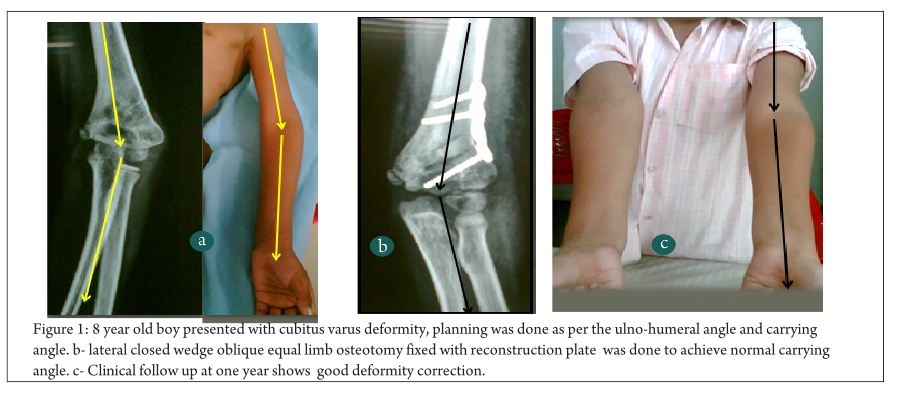
We advise surgical correction of all cubitus varus deformities but decision is to be made by the patient and parents after informed discussion about advantages and disadvantages. We prefer a lateral closed wedge oblique equal limb osteotomy using a lateral approach. Osteotomy is planned preoperatively taking into account the ulno humeral angle and clinically the carrying angle. Intraoperatively the wedge is resected and osteotomy is closed (Fig 1). Limb is aligned and carrying angle is checked. If the limb is still in varus, the osteotomy is extended to achieve >5° of carrying angle. Fixation is done using 3 or 4 hole reconstruction plate. Postoperative ???
Rehabilitation
Special situation
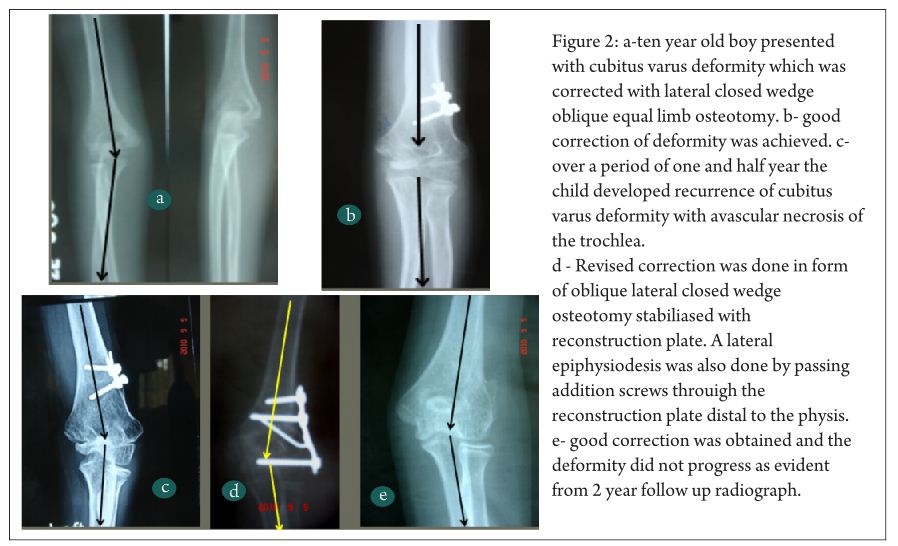
In cases where there is avascular necrosis of the trochlea or physeal arrest of the medial physeal plate, epiphysiodesis of the lateral physis is needed (depending on calculations of growth potential of the child). In such cases the supracondylar osteotomy needs to be combined with epiphysiodesis (Fig 2).

Figure 2

Conclusion
Cubitus varus deformity requires surgical correction or may lead to various consequences like secondary fractures, lateral instability and nerve palsies. Lateral closed wedge osteotomy is a good method to correct the deformity. Appropriate stabilisation preferably with plate and screw will minimise complications. Surgeons should be aware of complications and should counsel the patients for the same. The lateral bump index post correction and the appearance and placement of the scar are the two variables which may affect the cosmetic aspect of the correction and should be considered while decision making.


References

1. Tellisi N, Abusetta G, Day M et al (2004) Management of Gartland’s type III supracondylar fractures of the humerus in children: the role audit and practice guidelines. Injury 35:1167– 1171
2. Wong HK, Balasubramaniam P. Humeral torsional deformity after supracondylar osteotomy for cubitus varus: its influence on the postosteotomy carrying angle. J Pediatr Orthop. 1992 Jul-Aug;12(4):490-3.
3. . Oppenheim WL, Clader TJ, Smith C, Bayer M. Supracondylar humeral osteotomy for traumatic childhood cubitus varus deformity. Clin Orthop Relat Res 1984;(188):34– 39.
4. Takahara M, Sasaki I, Kimura T, et al. Second fracture of the distal humerus after varus malunion of a supracondylar fracture in children. J Bone Joint Surg [Br] 1998;80- B:791–797.
5. Davids JR, Maguire MF, Mubarak SJ, Wenger DR. Lateral condylar fracture of the humerus following posttraumatic cubitus varus. J Pediatr Orthop 1994;14:466– 470.
6. O’Driscoll SW, Spinner RJ, McKee MD, et al. Tardy posterolateral rotatory instability of the elbow due to cubitus varus. J Bone Joint Surg [Am] 2001;83-A:1358– 1369.
7. Abe M, Ishizu T, Morikawa J. Posterolateral rotatory instability of the elbow after posttraumatic cubitus varus. J Shoulder Elbow Surg 1997;6:405–409.
8. Mitsunari A, Muneshige H, Ikuta Y, Murakami T. Internal rotation deformity and tardy ulnar nerve palsy after supracondylar humeral fracture. J Shoulder Elbow Surg 1995;4:23–29.
9. Fujioka H, Nakabayashi Y, Hirata S, Go G, Nishi S, Mizuno K. Analysis of tardy ulnar nerve palsy associated with cubitus varus deformity after a supracondylar fracture of the humerus: a report of four cases. J Orthop Trauma. 1995;9(5):435-40.
a. Kawanishi Y, Miyake J, Kataoka T, Omori S, Sugamoto K, Yoshikawa H, Murase T. Does cubitus varus cause morphologic and alignment changes in the elbow joint? J Shoulder Elbow Surg. 2013 Jul;22(7):915-23.
10. Siris IE. Supracondylar fractures of the humerus: an analysis of 330 cases. Surg Gynecol Obstet 1939;68:201–222.
11. French PR. Varus deformity of the elbow following supracondylar fractures of the humerus in children. Lancet 1959;2:439–441.
12. King D, Secor C. Bow elbow (cubitus varus). J Bone Joint Surg [Am] 1951;33-A:572– 576.
13. Gong HS, Chung MS, Oh JH, Cho HE, Baek GH. Oblique closing wedge osteotomy and lateral plating for cubitus varus in adults. Clin Orthop Relat Res. 2008 Apr;466(4):899-906.
14. El-Adl W. The equal limbs lateral closing wedge osteotomy for correction of cubitus varus in children. Acta Orthop Belg. 2007 Oct;73(5):580-7.
15. DeRosa GP, Graziano GP. A new osteotomy for cubitus varus. Clin Orthop Relat Res. 1988 Nov;(236):160-5.
16. . Kanaujia RR, Ikuta Y, Muneshige H, Higaki T, Shimogaki K. Dome osteotomy for cubitus varus in children. Acta Orthop Scand 1988;59:314–317.
17. Pankaj A, Dua A, Malhotra R, Bhan S. Dome osteotomy for posttraumatic cubitus varus: a surgical technique to avoid lateral condylar prominence. J Pediatr Orthop. 2006 Jan-Feb;26(1):61-6.
18. Piskin A, Tomak Y, Sen C, Tomak L. The management of cubitus varus and valgus using the Ilizarov method. J Bone Joint Surg Br. 2007 Dec;89(12):1615-9.
19. Butt MF, Dhar SA, Farooq M, Kawoosa AA, Mir MR. Lateral invaginating peg (LIP) osteotomy for the correction of post-traumatic cubitus varus deformity. J Pediatr Orthop B. 2009 Sep;18(5):265-70.
20. Moradi A, Vahedi E, Ebrahimzadeh MH. Surgical technique: Spike translation: a new modification in step-cut osteotomy for cubitus varus deformity. Clin Orthop Relat Res. 2013 May;471(5):1564-71
21. Tanwar YS, Habib M, Jaiswal A, Singh S, Arya RK, Sinha S. Triple modified French osteotomy: a possible answer to cubitus varus deformity. A technical note. J Shoulder Elbow Surg. 2014 Nov;23(11):1612-7.
22. Bali K, Sudesh P, Krishnan V, Sharma A, Manoharan SR, Mootha AK. Modified step-cut osteotomy for post-traumatic cubitus varus: our experience with 14 children. Orthop Traumatol Surg Res. 2011 Nov;97(7):741-9.
23. Davids JR, Lamoreaux DC, Brooker RC, Tanner SL, Westberry DE. Translation step-cut osteotomy for the treatment of posttraumatic cubitus varus. J Pediatr Orthop. 2011 Jun;31(4):353-65.
24. Eamsobhana P, Kaewpornsawan K. Double dome osteotomy for the treatment of cubitus varus in children. Int Orthop. 2013 Apr;37(4):641-6.
25. Yun YH, Shin SJ, Moon JG. Reverse V osteotomy of the distal humerus for the correction of cubitus varus. J Bone Joint Surg Br. 2007 Apr;89(4):527-31.
26. Takeyasu Y, Oka K, Miyake J, Kataoka T, Moritomo H, Murase T. Preoperative, computer simulation-based, three-dimensional corrective osteotomy for cubitus varus deformity with use of a custom-designed surgical device. J Bone Joint Surg Am. 2013 Nov 20;95(22):e173.
27. Moon MS, Kim SS, Kim ST, Lee SR, Lee BJ, Jin JM, Moon JL. Lateral closing wedge osteotomy with or without medialisation of the distal fragment for cubitus varus. J Orthop Surg (Hong Kong). 2010 Aug;18(2):220-3.
28. Uchida Y, Ogata K, Sugioka Y. A new three-dimensional osteotomy for cubitus varus deformity after supracondylar fracture of the humerus in children. J Pediatr Orthop. 1991 May-Jun;11(3):327-31.
29. Usui M, Ishii S, Miyano S, Narita H, Kura H. Three-dimensional corrective osteotomy for treatment of cubitus varus after supracondylar fracture of the humerus in children. J Shoulder Elbow Surg. 1995 Jan-Feb;4(1 Pt 1):17-22.
30. Hui JH, Torode IP, Chatterjee A. Medial approach for corrective osteotomy of cubitus varus: a cosmetic incision. J Pediatr Orthop. 2004 Sep-Oct;24(5):477-81.
31. Banerjee S, Sabui KK, Mondal J, Raj SJ, Pal DK. Corrective dome osteotomy using the paratricipital (triceps-sparing) approach for cubitus varus deformity in children. J Pediatr Orthop. 2012 Jun;32(4):385-93.
32. Takagi T, Takayama S, Nakamura T, Horiuchi Y, Toyama Y, Ikegami H. Supracondylar osteotomy of the humerus to correct cubitus varus: do both internal rotation and extension deformities need to be corrected? J Bone Joint Surg Am. 2010 Jul 7;92(7):1619-26.
33. Solfelt DA, Hill BW, Anderson CP, Cole PA. Supracondylar osteotomy for the treatment of cubitus varus in children: a systematic review. Bone Joint J. 2014 May;96-B(5):691-700.
34. Raney EM, Thielen Z, Gregory S, Sobralske M. Complications of supracondylar osteotomies for cubitus varus. J Pediatr Orthop. 2012 Apr-May;32(3):232-40.
35. Cho CH, Song KS, Min BW, Bae KC, Lee KJ. Long-term results of remodeling of lateral condylar prominence after lateral closed-wedge osteotomy for cubitus varus. J Shoulder Elbow Surg. 2009 May-Jun;18(3):478-83.
36. Lee SC, Shim JS, Sul EJ, Seo SW. Remodeling after lateral closing-wedge osteotomy in children with cubitus varus. Orthopedics. 2012 Jun;35(6):e823-8
.


How to Cite this Article: Patwardhan S, Shyam AK. Cubitus Varus Deformity – Rationale of Treatment and Methods. International Journal of Paediatric Orthopaedics July-Sep 2015;1(1):26-29.        

Photo


(Abstract)      (Full Text HTML)      (Download PDF)